*Disclosure: This post contains affiliate links, and I may earn from purchases made after clicking those links. Disclosure Policy.
Did you know that June 28 is Carolina Day?
Better yet, even if you did know that June 28 is Carolina Day, do you know what it commemorates?
In this post, I’m going to cover the history behind Carolina Day, including what historical event happened on June 28 in South Carolina, why it was so significant, and what to expect during the annual celebration of Carolina Day on June 28.
So, read on to the learn all about Carolina Day!
When is Carolina Day?
Carolina Day is commemorated every year on June 28.
This is the anniversary of the date of the Battle of Sullivan’s Island, when an outgunned group of South Carolinians in a half finished fort, defeated a British fleet, a week before the Declaration of Independence.
It was one of the first significant engagements and patriot victories of what became South Carolina’s and the United States’s War for Independence.
In addition to affirming South Carolina’s willingness to fight for its independence, the battle’s legacy helped establish some of the state’s most enduring symbols, its nickname as the Palmetto State, the design of the state flag.
Hence why it’s celebrated as Carolina Day!
2026 Carolina Day Events
2026 not only marks 250 years since the US’s Declaration of Independence, but also the 250th Carolina Day.
There are special events around the state in honor of the anniversary.
Here are a handful:
- Fort Moultrie will have living history demonstrations, artillery firings, and more on June 27 and June 28. Check out this Facebook post or this page on their website for more details what to expect.
- The South Carolina State Museum in Columbia will have free admission and inaugurate their new exhibit called American Battleground: South Carolina’s Revolution on June 27 in the Salute to 250 Day.
- You can check the SC 250 website’s event page to look for other events closer to you.
History of the Battle of Carolina Day
Carolina Day commemorates the victory of a force led by Colonel William Moultrie over combined land and sea forces of Great Britain at the Battle of Sullivan’s Island.
Moultrie and his men had hastily constructed a fort, which they called Fort Sullivan, near the tip of Sullivan’s Island on the edge of Charleston harbor.
Ships entering the harbor had to pass directly in front of this spot, and Moultrie hoped a fort here could repel any attempt by the British to occupy the important trading port and capital of colonial South Carolina.
Moultrie and his men used the most readily available timber they could find: palmetto trees. They constructed their fort with two rows of palmetto logs filled with sand in the middle.
11 British warships arrived off the coast of Charleston, then still called Charlestown, in early June 1776, set to confront Moultrie and his fort, which was still less than halfway complete.
In fact, the second in command of the Continental Army, Charles Lee, who had arrived to inspect Charleston’s defenses the same day as the British, called the fort a “slaughterpen” and encouraged Moultrie to abandon it.
Moultrie refused, confident he and his men could hold it.
While history proved Moultrie correct, Lee’s characterization of the fort highlights how victory was far from guaranteed.
The attack finally came on the morning of June 28, with 9 of the British warships moving into position to fire on the fort.
As they let loose with broadside after broadside barrage against the fort, something surprising but spectacular happened: the palmetto logs were remarkably resilient to cannon fire.
Turns out the spongy, fibrous trees absorbed the cannon balls better than anyone could have imagined, shuddering and shaking but not splintering like most timber.
Moultrie and his men, even with limited gunpowder, made their own shots count, and by 9 pm, the British withdrew their ships after suffering many more casualties than the patriots.
They soon thereafter sailed way in what was an embarrassing defeat for them and an early boost to morale for the patriot cause.
News of the miraculous victory at Charleston spread alongside news of the signing of the Declaration of Independence just one week later.

South Carolina Becomes Known as the Palmetto State
In honor of the great victory and role played by the ubiquitous Palmetto trees that dot the Carolina coast, South Carolina would henceforth forever be known as the Palmetto State.
However, the victory at Sullivan’s Island contributed another symbol of the state: the mysterious crescent in the corner of the state flag that most people assume is a not so mysterious moon, perhaps like those you might see on a clear evening the right time of month on one of the Charleston beaches hovering over a palmetto, just like on the flag.
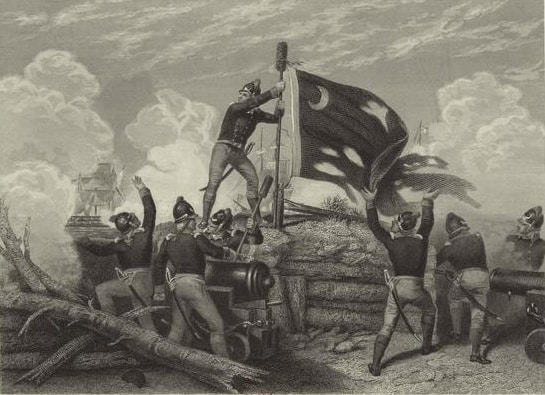
Before the battle, Moultrie had designed a flag with a blue field and crescent in the corner, which he flew over his palmetto log fort during the battle.
In fact, during one of the most memorable moments of the battle, the flag was shot from its staff. Sergeant William Jasper, leapt atop the ramparts to re-hoist it, where it remained until the battle was won.
It remained engrained in South Carolinian’s memory as well, and when the state flag was officially adopted, it honored Moultrie by using his design, with the crescent in the corner and a palmetto tree in honor of his fort that so valiantly withstood the British fire.
However, the exact meaning of the crescent is debated.
We do know from his memoirs that Moultrie specifically designed the flag to use the same symbol that appeared on the caps of his soldiers and that the indigo blue he used for his flag was the same color as their uniforms.
Some theories about the origin of the crescent include that it represented a medieval piece of armor or that it was a symbolic representation of Second Sons coming to South Carolina to make their fortune after being denied an inheritance in Britain.
Regardless, it’s clear it means more than just the pretty sight it appears to be at first glance, but instead pays homage to Moultrie’s and his men’s gallant victory.
Fort Sullivan was also renamed to Fort Moultrie in the colonel’s honor, and the two later forts that were constructed and updated here as it remained an active military installation through World War II also bore his name.
Fort Moultrie is now part of Fort Sumter National Monument. It remains one of Charleston’s best but often under appreciated historic sites.

How is Carolina Day Celebrated?
The first anniversary of the decisive battle was celebrated by Charlestonians on June 28, 1777.
Over time it continued to be celebrated in Charleston and around the state, sometimes called the Anniversary of the Battle of Fort Moultrie, Palmetto Day, or Sgt. Jasper’s Day.
By 1875, it seems to have become permanently known as Carolina Day.
Today, the National Park Service holds events in honor of Carolina Day every year, sometimes on June 28 and sometimes on the weekend or weekends closest to the anniversary of the battle.
Programs at Fort Moultrie vary year to year but often include living history presentations, cannon and musket firings, and reenactments of aspects of the battle. You can check this page to see what events are planned for this year.
Once again, ff you’d like to see what they’re planning at Fort Moultrie in 2026 for the 250th anniversary, check out this Facebook post or this page on their website for details what to expect.
The South Carolina State Museum in Columbia will also open a special new exhibit on independence and the important role South Carolina played in named American Battleground: South Carolina’s Revolution on June 27, 2026 in the Salute to 250 Day.
In addition to free admission that day, they’ll also be redisplaying the historic 2nd South Carolina regimental flag carried during the war for independence and housed at the Smithsonian the last several years.
You can also check the SC 250 website’s event page to look for other local events closer to you.
The Palmetto Society also usually organizes annual events, such as a commemorative church service, parades and speakers in Charleston.
St. Michael’s Church’s bells also toll Three Blind Mice on Carolina Day.
According to legend, the messenger who brought word of the victory to the city played the song from the church’s steeple.
Local libraries, museums, and historic societies around the state may host events or presentations in honor of Carolina Day as well.