*Disclosure: This post contains affiliate links, and I may earn from purchases made after clicking those links. Disclosure Policy.
The Battle of Sullivan’s Island, fought on the island of the same name outside Charleston, South Carolina, was one of the most important and most decisive patriot victories in the early American Revolution.
Among the earliest engagements in South Carolina, it also left a lasting legacy on the state and inspired some of its most recognizable and famous symbols.
Read on to learn all about the Battle of Sullivan’s Island and its legacy as we approach the 250th anniversary of this important early patriot victory.
History of the Battle of Sullivan’s Island
This post will cover the entire history of the Battle of Sullivan’s Island, starting with the background to the battle, the events of the battle, its significance for the larger American Revolution taking shape, and its legacy in shaping the symbols of South Carolina.
When Was the Battle of Sullivan’s Island?
The Battle of Sullivan’s Island took place on June 28, 1776.
That’s right, this important early decisive victory over British forces took place exactly a week before the signing of the Declaration of Independence on July 4, 1776.
Victory at Sullivan’s Island provided a significant morale boost to the early war effort, and it helped keep Charleston in patriot hands for several more years.
I’ll cover the battle’s impact in more detail below, but first, let’s look at the background and events themselves.
Background to the Battle at Sullivan’s Island
Following the initial engagements at Lexington and Concord in April and the defeat of patriot forces at Bunker Hill outside Boston by the British in May in 1775, pro-independence colonists began arriving in Charleston (then called Charelstown) to join militias.
In November 1775, patriot and loyalist forces fought in the battle known as the Siege of Savage’s Old Fields near Ninety Six, the first major engagement in South Carolina.
Their victory resulted in virtual patriot control of the entire territory of the colony of South Carolina.
Charleston, or Charlestown, as it was still known at the time, was one of the southern colonies’ most important trade ports and the capital of colonial South Carolina.
Keeping it in patriot hands was an important goal for the Continental Congress, while reasserting firm control of it was an early British goal.
In fact, with revolutionary fervor at a fever pitch in the northern colonies, the British hoped to establish a base of operations on the coast of the Carolinas where they could retake control of all the southern colonies.
At first, a combined force led by Major General Henry Clinton and Major General Charles Cornwallis attempted to set up this base of operations at Cape Fear, in North Carolina in the Spring of 1776.
However, by May 1776, Clinton and Cornwallis decided retaking Charleston would be a better goal, and their scouting indicated the city’s defenses were still only partially complete and could be easily defeated.

Fort Sullivan: the Palmetto Log “Slaughter Pen”
Among those defenses was a fort being hastily constructed by militia under the command of Colonel William Moultrie near the southern tip of Sullivan’s Island.
Large ships entering Charleston’s harbor had to navigate a complicated and treacherous set of shoals created by submerged sandbars known as the Charleston Bar.
The main safe channel into the harbor required them to pass just in front of the spot Moultrie chose to build his fort.
Moultrie and the 2nd South Carolina Regiment under his command had begun construction of the fort, which they called Fort Sullivan, in March 1776.
Their plans called for a square shaped fort, approximately 500 feet wide, with walls 20 feet high and 16 feet thick. They filled the space between walls with sand to stop the impact of cannon balls.
Wanting to construct it rapidly, they used the most readily available lumber: the plentiful palmetto trees that grow up and down the Carolina coast.
General Charles Lee, the Continental Army’s southern theater commander and second in command overall only after George Washington, visited Moultrie and his men in early June and was not impressed.
According to Moultrie’s memoirs, Lee described the palmetto log fort as a “slaughter pen” and thought it would be better off abandoned.
John Rutledge, president of South Carolina’s general assembly, and its de facto revolutionary head of state, ordered Moultrie to follow Lee’s command but ignore the order to abandon Fort Sullivan.

The British Arrive
Clinton’s and Cornwallis’s combined forces, escorted by a fleet of 11 ships under the command of Admiral Sir Peter Parker arrived off the Charleston coast in the opening days of June.
Originally believing they could ford the narrow channel between Long Island (now called Isle of Palms) and the northern end of Sullivan’s Island, Clinton had landed an infantry force there with plans to march on the fort.
However, the water was too deep for them to wade across the narrow channel between the two barrier islands, known as Breach Inlet.
So, the British infantry took up a defensive position across Breach Inlet, and they exchanged sporadic fire with patriot defenders on the other side in the following weeks.
Meanwhile, Moultrie’s fort still stood less than half complete, with only the seaward wall fully intact and with nothing but a crude wooden palisade protected its gunpowder reserves.
Admiral Parker even sent word to Clinton that his ground forces wouldn’t be necessary and that his ships should be able to easily demolish the fort, even boasting he could land his own land troops if necessary.
Lee also remained convinced of the fort’s weakness and attempted to create an elaborate bridge of boats to evacuate the fort.
With Moultrie stubbornly refusing to abandon the fort, Lee went as far to inform Rutledge that he was set to relieve Moultrie of his command on the morning of June 28.
However, the British attack finally came before he could take any such action.
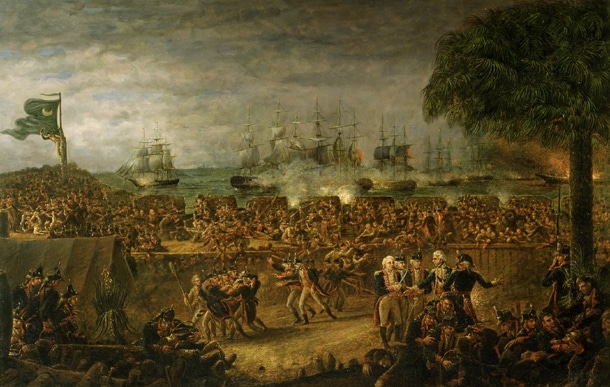
The Battle of Sullivan’s Island aka the Battle of Fort Moultrie
Around 9 am, as Moultrie inspected the makeshift defenses Colonel William Thomson had built at Breach Inlet, a flare went up from the British flagship, and 9 of the 11 British ships began moving into position to fire on the fort.
Moultrie galloped back to the fort to prepare his men to make their stand.
By 10 am, 3 of the British ships began lobbing mortar fire on the fort, as the other 6, led by the 50 gun ships of the line HMS Bristol and HMS Experiment, approached to within 400 yards of the fort, where they could let loose with the full fury of their broadside volleys onto Moultrie’s “slaughter pen.”
Meanwhile, Fort Sullivan was equipped with a hodgepodge of 31 guns of different sizes.
Furthermore, hoping to conserve their limited supply of gunpowder, Moultrie ordered that only 4 guns be fired at a time, and those only after careful aiming by officers.
According to Moultrie’s memoirs, as the ships approached, a Captain Lamperer, who had served in the British Navy, commented to Moultrie that “when those ships come to lay along side of your fort, they will knock it down in half an hour.”
Moultrie writes in his memoirs, with the benefit of hindsight mind you, that he never doubted the fort would stand.

Still, it’s hard to wonder how he couldn’t have had second thoughts as the booming sound and billowing smoke from the British cannon fire began to fill the air as they bore down on he and his heavily outgunned men.
In fact, his unwavering confidence, invented to dramatize his memoirs or not, proved to be well placed.
The fibrous, spongy palmetto logs absorbed the British cannonballs very effectively, not splintering like most timber, and the fort held in the face of the withering British fire.
Meanwhile, the fort’s defenders made their limited shots count. A British engineer present described them as “slow, but decisive indeed.”
As the day wore on, Lamperer’s prediction proved far from the truth, and events turned against what had at first glance appeared to be a easy British victory.
The British’s own miscalculations lended a helping hand.
With Parker’s ships unable to blast Fort Sullivan into submission, Clinton’s infantry forces attempted to cross Breach Inlet aboard small boats in order to assault it by land.
However, even with the cover from the remaning two British ships, blistering fire from grapeshot and the sharpshooters in Thomson’s detachment forced him to abandon this plan.
Around noon, 3 of the British ships attempted to flank the fort, hoping to open a line of direct fire on the firing platforms.
All three soon found themselves stuck on a submerged sandbar.
Sgt. Jasper and the Liberty Flag
In a fitting display of the resilience the fort and its defenders, the flag that Colonel Moultrie had designed for his regiment, a blue flag with a crescent in the corner was shot down by a stray British cannonball during the battle.
William Jasper, a young sergeant, grabbed the broken flag staff and hopped atop the rampart, exposing himself to the British cannon fire.
After waving it to rally his compatriots, he fastened it with a makeshift flagstaff.
Jasper’s action surely boosted the men’s morale and stands as one of the more memorable episodes in the opening days of the Revolution.

British Withdraw
As night fell, that flag and the fort was still standing strong.
The British called off the barrage around 9 pm and moved their ships out of cannon range to lick their wounds.
The British had lost 140 sailors, with at least 191 more wounded.
Meanwhile, there had been only 12 men killed and 25 wounded combined between Thomson’s detachment at Breach Inlet and the supposed “slaughter pen” of Moultrie’s Fort Sullivan.
The British had used 34,000 pounds of powder compared to the patriots’ 4,766 pounds.
While the British managed to get two of the grounded ships back afloat over the course of the afternoon, they were forced to abandon and set fire to the still grounded HMS Acteon. Patriots rowed out and looted the ship of what they could as it burned.
Clinton concluded the fleet was too heavily damaged to attempt any further immediate assault on Charleston.
He loaded his infantry back aboard, and sailed away.
Significance of the Battle at Fort Moultrie
The victory in the Battle of Sullivan’s Island helped provide an important morale boost during the early struggle for independence and kept Charleston in patriot hands for several more years.
Its legacy also has left an indelible symbolic impact on South Carolina.
Did the Victory Inspire the Declaration of Independence?
While a matter of boastful pride for South Carolinians and Charlestonians, it’s a bit more of a matter of debate among historians what, if any, impact the victory played in the decision to declare independence a week later.
As this great essay from Charleston native Seabrook Wilkinson points out, it’s unlikely the victory swayed the decision.
However, records of the Continental Congress’s meetings indicate that word of victory in Charleston was indeed discussed and considered highly significant in Philadelphia.
A letter from Lee reached them by the late afternoon of July 19 as they were preparing to adjourn for the day. Recognizing the significance of the victory, they immediately ordered that excerpts be published in newspapers, knowing the victory would provide a morale boost to pro-independence forces throughout the colonies.
Discussing the victory further and congratulating Lee, Moultrie, and Thomson was put at the top of the agenda for the following day.
Charleston Remained in Patriot Hands for a Time
The victory at the Battle of Sullivan’s Island also kept Charelston in patriot hands.
This meant the port could continue to function and help supply patriot forces, not only in the south, but also in the northern colonies, where the focus of the fighting was located over the next few years.
Clinton did return and successfully seize Charleston in 1780.
It’s impossible to know if Charleston had fallen in 1776 and Clinton had established a base of operations to keep the southern colonies in the fold from the start if the war would have played out differently, but it’s hard to imagine it would have helped the cause of independence.
The Palmetto State is Born
Perhaps the most undebateable legacy of the Battle of Sullivan’s Island is the symbols that came to represent South Carolina as a result.
The state became known as the Palmetto State in honor of the resilience to British cannon fire shown by the ubiquitous trees that dot the Carolina coast.
The tree became ubiquitous on regimental banners from the colony and eventual state, not to mention on everything from coffee cups to earrings to hats and t-shirts today.
Moultrie’s flag with its crescent in the corner and blue field, became the model for the South Carolina state flag design as well, with, you guessed it, a palmetto tree added in the center to pay homage to he and his men’s victory.
The iconic image of Jasper hoisting the flag also was adopted on the new SC license plate in honor of the 250th anniversary of the battle and US independence.

The fort was also renamed Fort Moultrie in the colonel’s honor, and it remained an active military installation, updated and rebuilt two times, until the end of World War II.
It is part of Fort Sumter National Monument today and, in my opinion, one of Charleston’s most underrated historic sites and a bit of a hidden gem.
The victory is also commemorated as Carolina Day on June 28 every year with celebrations at Fort Moultrie, in Charleston, and elsewhere in the state.
If you’d like to see what they’re planning at Fort Moultrie for the 250th anniversary, you can see the full details on this page on their website or a summary in this Facebook post.
The South Carolina State Museum in Columbia will also open a special new exhibit on independence and the important role South Carolina played in named American Battleground: South Carolina’s Revolution on June 27, 2026 in the Salute to 250 Day.
In addition to free admission that day, they’ll also be redisplaying the historic 2nd South Carolina regimental flag carried during the war for independence and housed at the Smithsonian the last several years.