*Disclosure: This post contains affiliate links, and I may earn from purchases made after clicking those links. Disclosure Policy.
You probably recognize the South Carolina flag.
A dark, almost royal blue, with a palmetto tree in the center and a crescent moon in the corner, almost like the perfect beach scene just after dusk on a breezy South Carolina evening.
Wait a minute!
That crescent, as much as it may look like one, might not be a moon at all. Its meaning is actually a matter of hot debate among South Carolinian historians.
It’s also rooted deeply in South Carolina history, even if it doubles as a nice landscape too.
Read on to learn about the meaning and history behind the South Carolina state flag, including just what that crescent might be.

South Carolina Flag Origins and History
We often take for granted that state flags have just always been around. However, they weren’t really a thing for most states in the United States until the Civil War.
In fact, the South Carolina state flag was originally adopted as the flag of the independent republic of South Carolina on January 26, 1861, just over a month after the state became the first to secede from the United States but before the formation of the Confederate States of America.
The original design for the flag adopted in 1861 had a crescent in the corner with a golden palmetto tree in a white oval and blue background.
However, this SC flag didn’t last long.
It eventually became known as the “2 day flag” because the SC General Assembly voted to change it on January 28, 1861, just 2 days after its original adoption.
The new design they chose consisted of the crescent in the corner and a simpler, white palmetto on the blue background, almost the same design as used today.
But, where did this design come from?
Why a palmetto tree? And why that crescent that looks so much like a moon?

The Moultrie Flag
South Carolina’s flag design can be traced to a flag designed by Colonel William Moultrie in the opening days of the American Revolution.
Moultrie commanded the 2nd South Carolina Regiment, which was founded in 1775 as war with Britain began and stationed in Charleston.
After he and his men occupied Fort Johnson, on James Island overlooking the entrance to Charleston harbor, they ran into a small issue: they had no flag!
As, Moultrie writes in his memoirs, “A little time after we were in possession of Fort Johnson, it was thought necessary to have a flag for the purpose of signals : (as there was no national or state flag at that time) I was desired by the council of safety to have one made, upon which, as the state troops were clothed in blue, and the fort was garrisoned by the first and second regiments, who wore a silver cresent on the front of their caps; I had a large blue flag made with a cresent [sic] in the dexter corner, to be in uniform with the troops.”
Why a Blue Field?
As long as we are taking a detailed look at the meaning of the South Carolina flag, we ought to ask why it’s blue too. And, not just any blue, but a certain, particular shade.
It’s clear Moultrie fashioned his flag in the same color as the caps and jackets of his men. But, where did that color come from, other than being distinct from the British redcoats?
It’s Indigo blue, derived from the tradition of producing dye from the Indigo cultivated in the South Carolina Lowcountry, which made it a logical choice for the color of uniforms and Moultrie’s flag.
Indigo blue was designated as the official state color in 2008 and it remains in use as the color on the flag of South Carolina.
Moultrie goes on to comment in his memoirs that the flag made those who wanted reconciliation with Great Britain a bit uneasy as it surely seemed like “a flag of defiance.”
This flag would earn its place in South Carolina and United States history not at Fort Johnson, but at another fort across the harbor where the other main symbol on the South Carolina flag entered the fold and Moultrie and his men did in fact defy the British.

The Palmetto Log Fort
Moultrie planned the construction of a fort on the southern end of Sullivan’s Island, directly overlooking the main channel into Charleston harbor to serve as a first line of defense against any British attempt to occupy Charleston.
Wanting to work hastily, he used the most readily available timber: the bountiful palmetto trees that grew on the island.
When a British fleet appeared off the coast in June 1776, the fort remained barely halfway complete.
General Charles Lee, second in rank only to George Washington in the Continental Army, visited Moultrie’s regiment and described the fort as a “slaughter pen,” urging Moultrie to abandon it.
However, Moultrie chose to stand fast.
His fort did too.
When the British fleet bombarded the fort on June 28, 1776, the spongy, fibrous palmetto logs proved to be exceptionally resilient, absorbing the shock of cannon balls better than most timber.
They buckled and swayed but didn’t splinter.
Moultrie’s blue flag with crescent flew over the fort as it withstood broadside after broadside from the British ships. One of the most famous moments of the battle was when the flag was temporarily shot down, and Sergeant William Jasper quickly replaced it, rallying his comrades in the process.
When the British finally silenced their cannons after nearly 12 hours of bombardment, the flag remained.
Learn more about the battle in this history of the Battle of Sullivan’s Island.
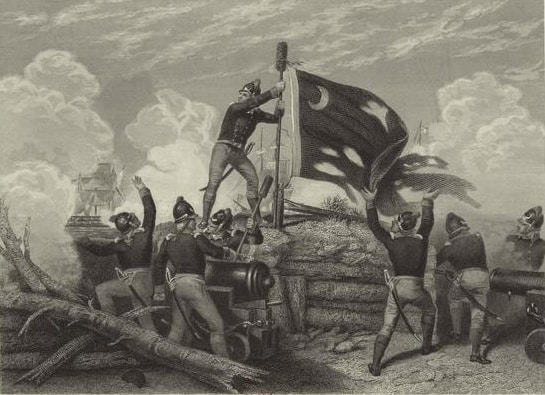
The Liberty Flag
The British fleet sailed away, leaving Charleston in patriot hands until 1780 and forever emblazing the blue flag and crescent as a symbol of liberty in South Carolina.
Other militia units in the colony adopted the flag or variations of it during the War for Independence. In 1782, after the reliberation of Charleston and effective ending of the war in South Carolina, General Nathanael Green flew the flag over the city.
Depictions of the flag vary, sometimes with liberty written within the crescent or along the bottom of the flag. However, it seems Moultrie’s original design had a simple, white, slanted crescent on a blue field.
It and the palmetto tree became closely associated with South Carolina. The crescent or palmetto tree or both were often displayed on flags.
With the 250th anniversary of independence approaching, the state adopted the flag and the iconic image of Sgt. William Jasper hoisting it atop the fort as the new license plate design.
I don’t mind the design, but it has generated some debate as this article points out and the comments in this Reddit thread and may others make very clear.
Flag of the Republic of South Carolina
The current SC state flag was actually the flag of the short lived Republic of South Carolina before the founding of the Confederacy and the Civil War.
When secession came, the palmetto and crescent were adopted once again as a symbol of defiance, even if it contradicted that word liberty it was so often associated with.
I love our flag. I love that the design has more than meets the eye, and I think the story behind it is fascinating and much too under-appreciated.
I happen to think it just looks cool too.
But, its adoption in 1861 is also a reminder of the less savory and difficult to confront parts of our state’s history.
South Carolina State Flag Design
When the flag was officially adopted, the crescent was placed vertically, with its points facing upwards.
However, it was adjusted to the angle in its current design in 1910.
Curiously enough, the South Carolina state flag has not had an officially designated and uniform design since the repeal of a flag code in 1940.
This means slight variations in the exact color and design of the palmetto vary from flag manufacturer to flag manufacturer, not to mention swag manufacturer to swag manufacter.
A 2020 study committee attempted to create a new consistent and uniform design, but its original proposal was widely panned, leading to two more proposed designs.
However, as of this publication in June 2025, no official uniform code has been adopted by the SC state legislature. As this article points out, this is a bit problematic as even variations in the same government building might look slightly different.

So, If Not a Moon, What is It?
Well, the truth is we don’t know for sure.
It’s clear the design of the flag of the state of South Carolina was directly inspired by Moultrie’s flag and the mythical role of the palmetto tree in the defense of Fort Sullivan, not by the idyllic sight of a crescent moon hanging over a palmetto on a gorgeous South Carolina evening, perhaps at one the state’s many beautiful beaches like Isle of Palms.
According to this interesting article, the earliest possible use of the symbol was on caps of South Carolina militia raised February 1760 to fight the Cherokee, although there’s some debate whether that is true. This article asserts that claim is based on inaccurate records, and the first confirmed use was in 1773, again on South Carolina militia uniforms.
Moultrie himself offers no explanation or inspiration for the use of the symbol on his flag apart from the mention that the men in his regiment had the crescent symbol on their caps, as stated in the quote above.
What we have instead is a lot of speculation by historians.
The Gorget Theory
Perhaps the most common explanation, besides the assumption that it is a moon, is that the crescent represents a gorget.
A gorget is a piece of cloth, leather, or armor to protect the neck that dates to at least the medieval period and perhaps before.
By the 18th century, it served more as an ornamental piece worn as a collar or necklace on a chain or ribbon, and was most commonly worn by infantry officers.
Both British and French officers wore gorgets into the 1800s, some German officers wore them even in World War II.
The original vertical appearance of the crescent on regimental caps and Moultrie’s flag would seem to suggest the possibility the symbol was meant to represent a gorget, perhaps as an homage to their ornamental use by British officers.
Remember the officers of the 2nd South Carolina would have been British officers just months before.
Or perhaps they chose the symbol to represent how they saw themselves as the protectors of liberty. The gorget did protect the vital veins and arteries of the neck, the literal lifeline of the body.
When I worked at Fort Sumter and Fort Moultrie as a college student, this was by far the most popular interpretation among fellow park rangers.
In fact, when I sat down to write this article, I had planned to argue as much. Plus, I couldn’t resist the Star Wars reference in the title.
Other Theories: Maybe it is a Moon, Afterall
However, convincing as it might seem to be and clever (or nerdy) as the reference might be, there’s no hard, written evidence that the crescent represents a gorget. The theory seems to be more legend and myth than based on historic record.
This article, also linked above, proposes another theory.
According to it, a surviving draft of the commission for those units in 1760 includes a sketch of the family seal of Lieutenant Governor William Bull, Jr., which includes a crescent. So, according to this theory, the inspiration for the symbol on the militia caps may have come from that.
That article goes on to speculate that the featuring of a crescent on the Bull family crest may have stemmed from the prominence of Second Sons coming to colonial South Carolina to make their fortunes since tradition held that First Sons inherited all their fathers’ estate (the sun) and Second Sons received nothing (the moon).
That also seems plausible enough, but again, there’s no hard evidence other than this tenuous link. Not to mention the fact that Bull remained a loyalist and fled to Britain upon independence.
However, this very detailed article from the Charleston Public Library, points out that John Rutdledge, president of South Carolina’s General Assembly and de facto governor during the Revolutionary period and author of the US Constitution, also had crescents on his family seal, lending some more credence to this theory and making it very likely it was a common symbol by prominent colonists.
That article goes on to suggest the symbol may have just been a symbol of a harvest moon, something that would have been easily and immediately recognizable to residents of Charleston and the rest of the colony. They would have understood it as representing hope for the future, in this case an independent future.
That article, with its very detailed look at historical uses of the symbol within the state is worth the read if you want to learn more.
So, maybe it is a moon on the South Carolina flag after all.
I’m keeping my Star Wars reference in the title though, because it’s certainly more than what first meets the eye or the simple moon many assume it is.
Plus, maybe it is a gorget.
Or maybe it’s something else entirely.
What it is, undoubtedly though, is a symbol of the sons, second or otherwise, of South Carolina fighting and dying bravely for causes they have seen fit to fight and die for, including their stand in one of the first significant victories of the struggle for United States independence, one I’m a personally much more proud of than the one they took in 1860.
So whether you’re donning it on a cap of your own or drinking out of a cup with it, perhaps while contemplating a bright crescent moon hanging over a palmetto at one of the Charleston beaches, remember there’s more to be proud of and contemplate in our state’s history than just that idyllic view.